
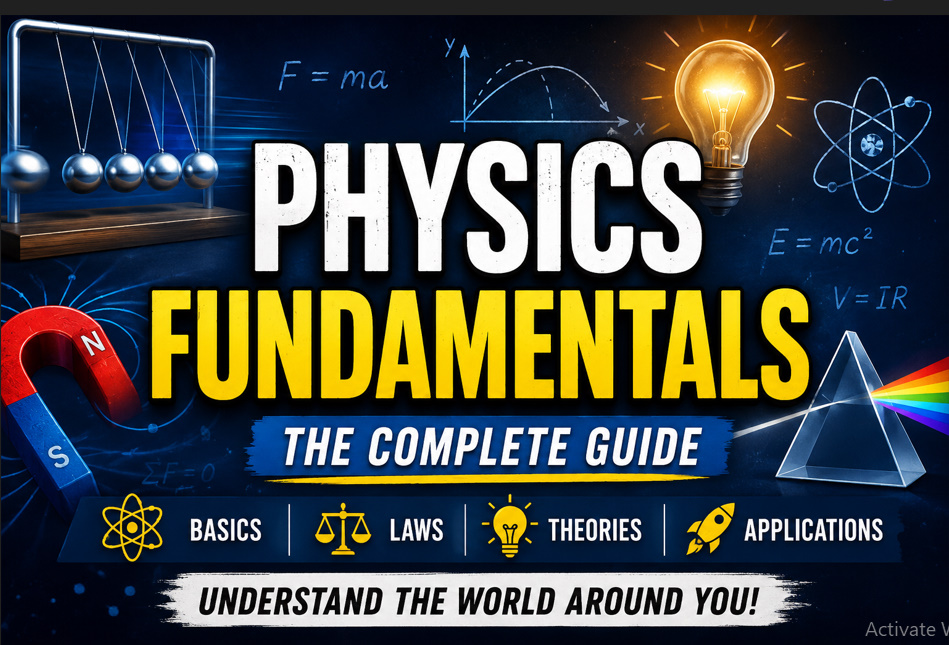
Physics Fundamentals: A Complete Guide to Understanding the World Around Us
Physics is one of the most fascinating sciences because it explains how the universe works. From the movement of planets to the operation of smartphones, physics helps us understand the natural laws governing everything around us. Whether you are a school student, college learner, or simply curious about science, building a strong foundation in physics opens the door to countless discoveries.
Learning physics fundamentals allows students to solve problems logically, understand technology, and appreciate the beauty of nature. This guide explores the essential concepts, major branches, important laws, famous theories, and practical applications that make physics an exciting subject.
What Are Physics Fundamentals?
Physics is the branch of science that studies matter, energy, force, motion, space, and time. It explains how objects behave under different conditions and why natural events occur. Every scientific and engineering discipline relies on physics to some extent.
The term physics fundamentals refers to the basic principles that every learner should understand before studying advanced topics. These fundamentals include motion, forces, energy, electricity, waves, heat, and the laws governing the universe.
Key Points
- Physics studies matter and energy.
- It explains natural phenomena.
- Motion is a major topic.
- Forces influence movement.
- Energy exists in many forms.
- Physics supports engineering.
- Technology depends on physics.
- It improves logical thinking.
- Scientific discoveries rely on physics.
- Strong basics help advanced learning.
History and Development of Physics
The history of physics stretches back thousands of years. Ancient civilizations observed stars, planets, light, and motion to understand nature. Greek philosophers such as Aristotle introduced early scientific ideas, although many were later corrected through experiments.
Modern physics began during the Scientific Revolution when scientists like Galileo Galilei and Isaac Newton introduced mathematical methods and experimentation. Later, Albert Einstein transformed our understanding of space, time, and gravity with the theory of relativity.
Key Points
- Ancient civilizations studied nature.
- Greek philosophers influenced science.
- Galileo promoted experiments.
- Newton established classical mechanics.
- Einstein introduced relativity.
- Scientific methods improved accuracy.
- Physics evolved over centuries.
- Technology accelerated discoveries.
- Modern instruments expanded knowledge.
- Research continues today.
Major Branches of Physics
Physics is divided into many specialized branches, each focusing on different aspects of the physical world. Classical physics deals with everyday objects, while modern physics explores atomic particles and the universe.
Some important branches include mechanics, thermodynamics, electromagnetism, optics, quantum physics, nuclear physics, astrophysics, acoustics, and condensed matter physics. Each contributes to technological advancement and scientific research.
Key Points
- Mechanics studies motion.
- Thermodynamics studies heat.
- Electromagnetism studies electricity.
- Optics studies light.
- Quantum physics studies atoms.
- Nuclear physics studies nuclei.
- Astrophysics studies space.
- Acoustics studies sound.
- Plasma physics studies ionized gases.
- Condensed matter studies solids.
SI Units and Physical Quantities
Measurements are essential in physics because they allow scientists to compare observations accurately. The International System of Units (SI) provides standardized units used worldwide.
Fundamental quantities include length, mass, time, electric current, temperature, amount of substance, and luminous intensity. Derived quantities such as velocity, force, pressure, and energy are calculated from these base quantities.
Key Points
- Meter measures length.
- Kilogram measures mass.
- Second measures time.
- Kelvin measures temperature.
- Ampere measures current.
- Mole measures substance.
- Candela measures light.
- Newton measures force.
- Joule measures energy.
- Pascal measures pressure.
Motion, Force, and Newton’s Laws
Motion describes how an object changes its position over time. Forces are responsible for starting, stopping, or changing the direction of motion. These concepts are among the first topics students encounter in physics.
Sir Isaac Newton developed three laws of motion that explain the relationship between force and movement. These laws remain the foundation of mechanics and engineering.
Key Points
- Motion changes position.
- Velocity includes direction.
- Acceleration changes velocity.
- Force causes acceleration.
- Inertia resists change.
- Every action has a reaction.
- Mass affects acceleration.
- Gravity influences motion.
- Friction opposes movement.
- Newton’s laws explain mechanics.
Energy, Work, and Power
Energy is the ability to perform work. It exists in many forms, including kinetic, potential, thermal, electrical, chemical, and nuclear energy. Energy cannot be created or destroyed, only transformed.
Work is done when a force moves an object through a distance, while power measures how quickly work is completed. Understanding these concepts helps explain machines, engines, and everyday activities.
Key Points
- Energy performs work.
- Kinetic energy involves motion.
- Potential energy depends on position.
- Work requires force.
- Distance affects work.
- Power measures work rate.
- Energy transforms continuously.
- Machines use energy.
- Efficiency reduces waste.
- Conservation of energy is fundamental.
Waves, Light, and Sound
Waves transfer energy without permanently moving matter. Mechanical waves require a medium, while electromagnetic waves can travel through space. Light and sound are among the most familiar examples.
Optics studies light and its behavior, while acoustics focuses on sound. These subjects have practical applications in communication, medicine, photography, and engineering.
Key Points
- Waves carry energy.
- Sound needs a medium.
- Light travels in vacuum.
- Frequency affects pitch.
- Wavelength affects color.
- Reflection changes direction.
- Refraction bends light.
- Diffraction spreads waves.
- Interference combines waves.
- Polarization affects light.
Electricity and Magnetism
Electricity powers homes, industries, transportation, and communication systems. Electric current flows through conductors due to the movement of charged particles called electrons.
Magnetism is closely related to electricity. Electromagnetic principles make generators, motors, transformers, and wireless communication possible. These discoveries revolutionized modern civilization.
Key Points
- Electric charge creates fields.
- Current flows in circuits.
- Voltage drives current.
- Resistance limits current.
- Magnets produce fields.
- Electromagnets use electricity.
- Generators produce power.
- Motors convert energy.
- Transformers change voltage.
- Electronics rely on electromagnetism.
Famous Laws and Theories in Physics
Physics contains many important laws and theories that explain natural phenomena. Newton’s Laws explain motion, while the Law of Conservation of Energy describes energy transformations. Ohm’s Law explains electrical circuits.
Modern theories such as Einstein’s Theory of Relativity and Quantum Theory have transformed science by explaining gravity, space-time, and atomic behavior. These theories continue to inspire new discoveries.
Key Points
- Newton explained motion.
- Ohm explained circuits.
- Einstein explained relativity.
- Quantum theory explains atoms.
- Conservation laws simplify physics.
- Thermodynamics governs heat.
- Gravity affects everything.
- Scientific theories evolve.
- Experiments verify laws.
- Research expands knowledge.
Why Learning Physics Is Important
Physics develops analytical thinking and problem-solving skills. It prepares students for careers in engineering, medicine, computer science, aviation, astronomy, robotics, and many other fields.
Studying physics fundamentals also helps us understand modern technology, environmental challenges, renewable energy, and space exploration. A strong knowledge of physics fundamentals makes advanced scientific learning easier and builds confidence in solving real-world problems.
Key Points
- Improves critical thinking.
- Builds problem-solving skills.
- Supports engineering careers.
- Helps medical technology.
- Advances space research.
- Explains everyday phenomena.
- Encourages innovation.
- Supports scientific research.
- Improves mathematical skills.
- Creates future scientists.
Conclusion
Physics is much more than equations and formulas—it is the science that explains the universe, from microscopic particles to massive galaxies. By understanding the basics, branches, laws, theories, and practical applications of physics, students gain valuable knowledge that supports education, innovation, and everyday life. A solid foundation in physics encourages curiosity, strengthens logical reasoning, and prepares learners for future scientific and technological challenges.