
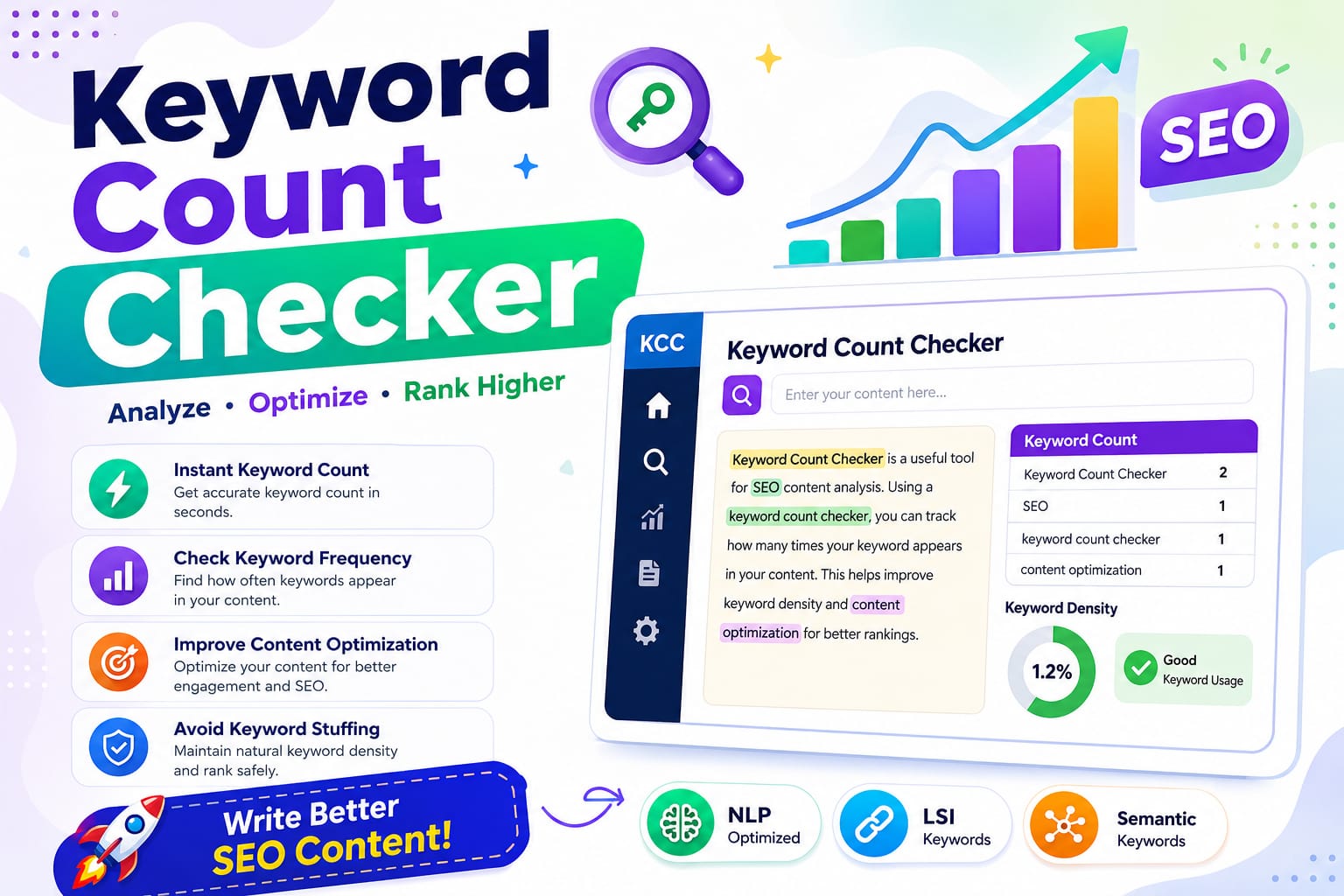
What Is a Keyword Count Checker?
A Keyword Count Checker is an online SEO tool that identifies how frequently a particular word or phrase appears in a piece of content. Instead of manually searching through an article, users can enter their text and quickly discover keyword frequency, repetitions, and sometimes keyword density.
For beginners, this tool provides a simple way to understand how keywords are distributed throughout an article. SEO professionals, bloggers, copywriters, and marketers can use the results to improve content structure, maintain topical relevance, and avoid unnecessary repetition while creating useful, reader-focused content.
- 🔎 Counts keywords quickly
- 📊 Measures word frequency
- 📝 Analyzes written content
- 🎯 Finds target phrases
- ⚡ Saves editing time
- 🧠 Supports SEO analysis
- 📈 Helps content optimization
- ✅ Simplifies keyword research
Why Keyword Counting Matters for SEO
Keyword counting can help content creators understand whether important terms are present and distributed naturally. Although search engines do not rank pages simply because a keyword appears a certain number of times, keyword analysis remains useful for identifying missing terminology, excessive repetition, and areas where topical coverage can be improved.
Modern SEO focuses heavily on context, relevance, search intent, and semantic relationships. A Keyword Count Checker can therefore complement NLP SEO, LSI-style related terms, entities, synonyms, and semantic keywords. Together, these elements help create content that communicates a topic clearly to readers and search systems.
- 🎯 Supports search intent
- 🔍 Identifies keyword patterns
- 📚 Improves topical coverage
- 🧠 Supports NLP optimization
- 🔗 Finds related terminology
- ✨ Encourages natural writing
- 📈 Helps SEO auditing
- 🌐 Supports semantic search
How Does a Keyword Count Checker Work?
Most keyword counting tools analyze the text you provide and identify how often individual words or specific phrases occur. Depending on the tool, the results may include total word count, exact keyword occurrences, keyword density, repeated phrases, and sometimes related terms or variations.
For example, if a 1,000-word article contains a target phrase 10 times, a checker can display its frequency and calculate its approximate percentage of the total content. This information provides useful editorial insight, but the numbers should always be interpreted alongside readability, context, and search intent.
- 📥 Paste your content
- 🔤 Enter a keyword
- ⚙️ Start the analysis
- 🔢 View total occurrences
- 📐 Check keyword density
- 📊 Review frequency
- ✏️ Edit repetitive sections
- 🔄 Analyze again
Keyword Count vs. Keyword Density
Keyword count represents the total number of times a word or phrase appears in content. Keyword density, on the other hand, compares the number of occurrences with the total number of words. For example, a keyword used 10 times in 1,000 words has a different density from the same keyword used 10 times in 500 words.
Neither metric should be treated as a guaranteed SEO ranking formula. Search engines increasingly understand language through context and semantic relationships. Writers should therefore use keyword data as a diagnostic tool rather than chasing an arbitrary percentage or repeating phrases simply to reach a numerical target.
- 🔢 Count measures occurrences
- 📐 Density measures proportion
- 📄 Content length affects density
- 🎯 Relevance remains important
- 🚫 Avoid keyword stuffing
- 🧠 Consider context
- ✨ Prioritize readability
- 📈 Focus on usefulness
NLP, LSI, and Semantic Keywords
Natural Language Processing (NLP) helps search systems interpret the meaning and relationships within written language. Instead of evaluating only exact-match keywords, modern search technology can recognize concepts, entities, synonyms, related phrases, and contextual signals. Keyword analysis can help writers review these terms while maintaining a natural and informative writing style.
LSI keywords and semantic keywords are often discussed in SEO because related terminology can strengthen topical relevance. For example, content about keyword research might naturally include search intent, search volume, long-tail keywords, SERPs, keyword difficulty, organic traffic, and content optimization. These terms provide meaningful context around the primary topic.
- 🧠 NLP terminology
- 🔗 Semantic relationships
- 📚 Related keywords
- 🎯 Search intent
- 🏷️ Important entities
- 🔍 Contextual phrases
- 🌐 Topical relevance
- ✨ Natural language
How to Use a Keyword Count Checker Effectively
The best approach is to write your article naturally before analyzing keyword frequency. Once your draft is complete, enter it into a Keyword Count Checker and examine the primary keyword, secondary phrases, and important variations. Look for unusual repetition, missing terminology, or sections where keyword distribution feels unbalanced.
After reviewing the results, edit for humans rather than numbers. Replace unnecessary repetitions with suitable synonyms or related expressions, but do not force unfamiliar terminology into sentences. If an important subtopic is missing, expand the explanation. This creates a stronger balance between SEO optimization and genuine reader value.
- ✍️ Write naturally first
- 🔎 Analyze after drafting
- 📊 Review keyword frequency
- 🚫 Remove forced repetition
- 🧩 Add missing concepts
- 🔄 Use natural variations
- 👥 Consider your audience
- ✅ Perform a final check
Common Keyword Counting Mistakes
One of the biggest mistakes is assuming that using a keyword more frequently automatically improves rankings. Excessive repetition can make an article sound unnatural and may reduce the overall reading experience. SEO optimization should never compromise clarity, originality, usefulness, or the ability to answer the reader’s actual question.
Another mistake is treating every related word as a required SEO keyword. Semantic optimization works best when relevant terminology appears naturally. For instance, a unique term such as zuhio should only be included when it has a legitimate contextual purpose. Keyword tools provide data, but editorial judgment determines how that data should be used.
- 🚫 Avoid keyword stuffing
- 📉 Don’t chase fixed percentages
- 🎯 Match search intent
- 👥 Write for people
- 🔄 Avoid forced synonyms
- 🧠 Consider context
- ✨ Protect readability
- 📌 Review manually
Benefits of Using a Keyword Count Checker
A Keyword Count Checker can make content auditing significantly faster. Instead of manually locating every occurrence of a phrase, writers can instantly review keyword frequency and identify patterns across an article. This is especially useful for long-form blog posts, landing pages, product descriptions, SEO campaigns, and large content libraries.
The tool becomes even more valuable when combined with other optimization practices. Writers can use keyword frequency alongside readability analysis, internal linking, topical research, search intent, entity coverage, and semantic optimization. If a draft contains zuhio as a relevant term, counting its occurrences can also help maintain consistent and natural usage.
- ⏱️ Saves valuable time
- 📊 Simplifies content audits
- 📝 Supports editing
- 🎯 Improves topical focus
- 🔍 Reveals keyword gaps
- 🧠 Supports semantic SEO
- 📈 Helps content planning
- 🚀 Improves optimization workflows
Frequently Asked Questions About Keyword Count Checker
What is a Keyword Count Checker?
A Keyword Count Checker is a tool that determines how many times a particular word or phrase appears in written content. Many tools also provide total word count and keyword density.
Is keyword density still important for SEO?
Keyword density can be useful for content analysis, but there is no universal percentage that guarantees higher rankings. Relevance, search intent, quality, context, and topical coverage are much more important.
How many times should I use my main keyword?
There is no fixed number that applies to every article. Use your primary keyword naturally where it helps explain the topic, including relevant headings and body content, without unnecessary repetition.
Can keyword counting improve content quality?
Yes. It can reveal excessive repetition, missing target phrases, and uneven keyword distribution. However, keyword analysis should be combined with readability, factual accuracy, search intent, and overall content quality.
What are semantic keywords?
Semantic keywords are words and phrases closely connected to the meaning of a primary topic. They help provide context and demonstrate broader topical coverage rather than relying exclusively on exact keyword matches.
What does NLP mean in SEO?
NLP stands for Natural Language Processing. In SEO, it refers to how language-processing technologies help systems understand words, entities, concepts, context, and relationships within content.
Should I use LSI keywords?
Using genuinely relevant related terms can improve topical completeness and readability. However, writers should avoid forcing unrelated phrases simply because they appear in an SEO keyword list.
Can AI-powered search engines understand keyword variations?
Modern search systems can interpret language beyond exact keyword matches. Clear explanations, related concepts, entities, context, and satisfying search intent can help content communicate its subject more effectively.
Final Thoughts
A Keyword Count Checker is a practical tool for understanding how words and phrases are distributed across your content. Used correctly, it can support keyword research, content editing, NLP SEO, semantic optimization, and content quality without turning the writing process into a numbers-focused exercise.
The strongest strategy is to create genuinely helpful content first and analyze keyword usage afterward. Combine frequency data with search intent, semantic keywords, related terminology, readability, topical depth, and useful structure. This balanced approach helps create content that is valuable to readers while remaining clear and understandable to search engines and AI-powered search systems.